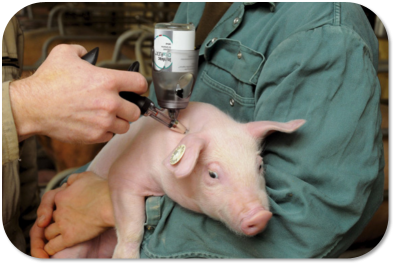
We all know that piglets are prone to anemia after birth and need iron supplementation. But did you know that improper iron injection, especially injecting too early or at too high a dose, is a hidden culprit behind polyarthritis?
Based on an in-depth study in Sweden involving more than 1,700 pigs, let us decode this phenomenon.
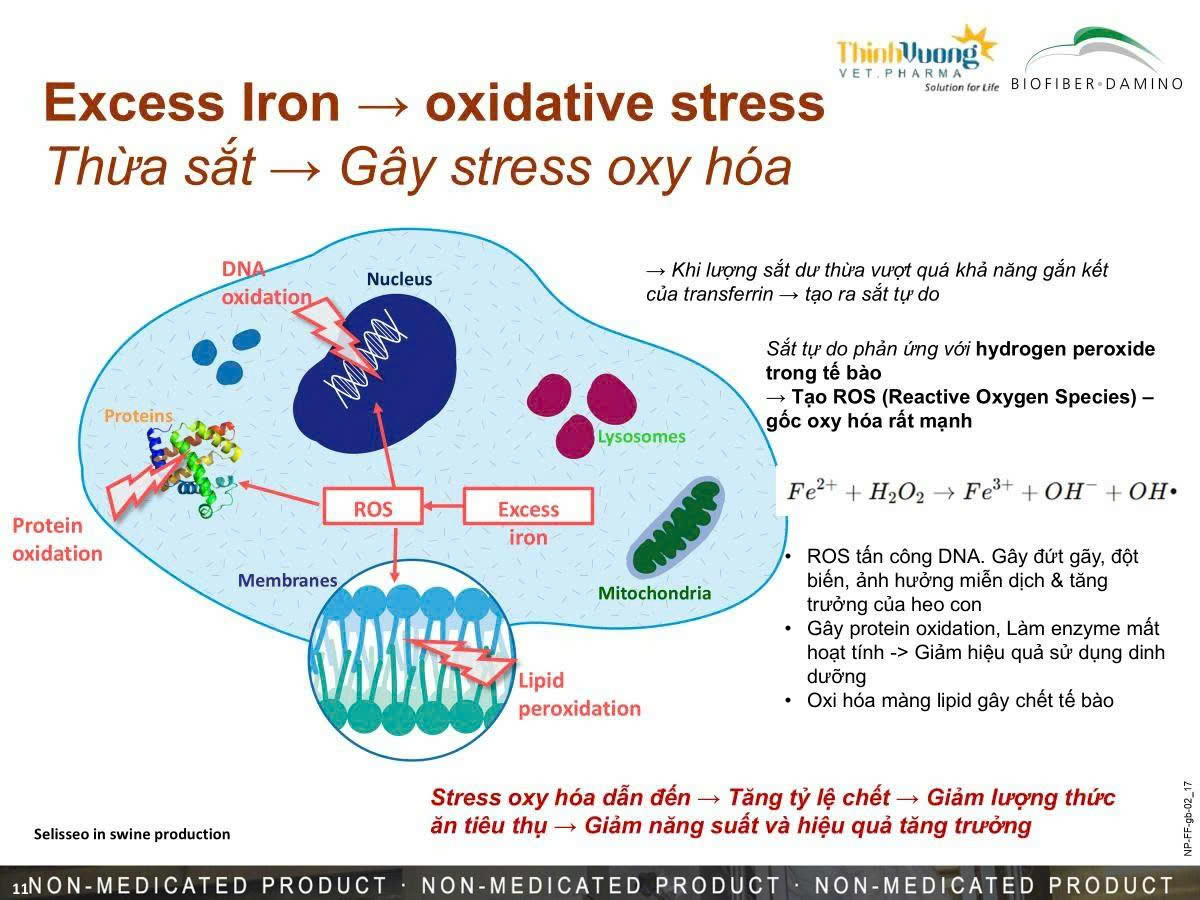
Iron is an essential nutrient, but when a large amount (about 200 mg of iron dextran) is injected into a newborn piglet, an “overload” occurs:
A scientific study by N. Holmgren, Swedish Animal Health Service, Skara, Sweden (from the Proceedings of the 14th IPVS Congress, Bologna, Italy, 7-10 July 1996) showed that:
Timing of injection is “golden”: Pigs injected with iron on the first day after birth had the highest incidence of arthritis (about 10%), whereas when injected on day 5 this rate fell markedly.
Injection vs. oral route: Intramuscular injection pushed the incidence of arthritis up to 20%, nearly double that of oral iron administration (11.1%).
The importance of vitamin E: Pigs given a vitamin E injection before the iron injection had a reduced disease incidence, from 16.8% down to 9.7%.
These results were obtained from a blind, split-litter study conducted on 1,737 pigs in 3 herds:
Trial A: Piglets were divided into 3 groups: (1) injected with 200 mg iron (iron dextran) on day 1; (2) injected with 200 mg iron on day 5; (3) no iron injection. All groups had access to iron-rich peat (150 mg iron/liter) until weaning at 5 weeks of age.
Trial B: Intramuscular (i.m.) injection of 200 mg iron (half of the litters) was compared with oral administration of 50 mg iron (half of the litters) (as iron glutamic acid) on the first day. The whole herd was given iron as 3% glutamic acid (mixed into the drinking water) from day 2 until weaning at week 5.
Trial C was divided into 2 groups: Group 1: intramuscular injection of 100 mg tocopheryl acetate (vitamin E) on the first day; Group 2: no vitamin E injection. Common intervention for both groups: all pigs in both groups were challenged (“stressed”) by intramuscular injection of 200 mg iron dextran on day 3 and day 15 after birth. This was intended to determine whether vitamin E helps reduce the incidence of arthritis when pigs receive a large iron load.
RESULTS OF TRIAL A
| Trial batch | Injected on day 1 (incidence) | Injected on day 5 (incidence) | Not injected (incidence) |
|---|---|---|---|
| 1 | 9.0% (257) | 7.4% (258) | 3.9% (255) |
| 2 | 10.4% (125) | 4.9% (122) | 2.5% (121) |
| 3 | 10.7% (197) | 3.5% (199) | 4.4% (203) |
| Total | 9.8% (579) | 5.5% (579) | 3.8% (579) |
Trial A: The incidence of polyarthritis was highest in the group injected on day 1 (about 10%). The group injected on day 5 had a lower incidence (p<0.01), and the non-injected group had the lowest incidence (p<0.001).
In Trial B, results were recorded when 236 pigs in the intramuscular group were sampled and examined, showing a polyarthritis incidence of 20.0%, compared with 11.1% in the oral iron group, in which 234 pigs were sampled (p<0.01).
Trial C: Similarly, the group injected with vitamin E before the iron injection had a disease incidence of 9.7% (258 pigs sampled), whereas the group without vitamin E had 16.8% (256 pigs sampled) (p<0.05). From this we can see that intramuscular injection of 200 mg iron causes iron overload, saturating the iron-binding capacity of transferrin. Iron overload reduces resistance to invading microorganisms because bacteria need free iron to grow. In addition, excess iron catalyzes the formation of free radicals such as O⁻ and OH, causing lipid peroxidation of cell membranes and impairing macrophage function.
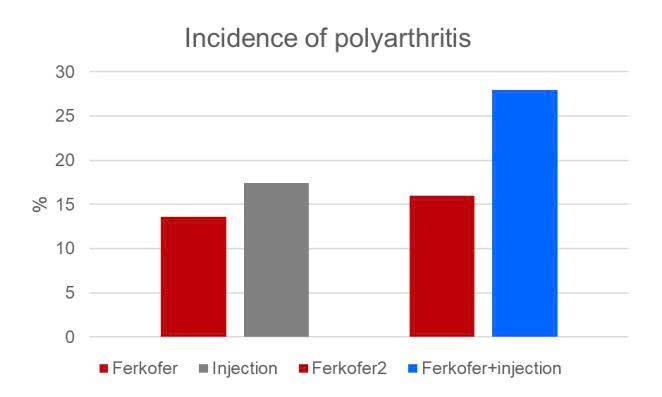
In addition, there is another study by Rantzer et al. in 2009. Two experiments were conducted to assess the risk of polyarthritis in pigs between conventional iron injection and natural iron feeding: Experiment 1: 41 litters, 225 piglets. Feeding Ferkofer was compared with conventional iron injection (200 mg/piglet). Experiment 2: 40 litters, 228 piglets. Feeding Ferkofer was compared with conventional iron injection combined with additional Ferkofer feeding. Parameter monitored: incidence of polyarthritis.
The results showed that injection of 200 mg → causes iron overload → residual free iron in the blood. Iron is an essential factor for most bacteria. Bacteria that cause arthritis (Streptococcus, E. coli, etc.) proliferate strongly in the presence of free iron. In addition, iron overload → reduced natural resistance, which lowers the ability to resist invading bacteria.
To ensure pigs do not become anemic while also avoiding the risk of polyarthritis, experts draw 3 vital recommendations:
Don’t rush to inject too early
The iron transport system of piglets in the first 24 hours of life is still very weak. If possible, postpone iron injection to day 3 to day 5 so that the piglet’s body is better prepared.
Supplement vitamin E, a protective “shield”
Vitamin E acts as an antioxidant, helping to neutralize the harmful free radicals caused by iron. Ensuring that sows are fed sufficient vitamin E, or injecting vitamin E into piglets, is the key to reducing the incidence of lameness.
Hygiene comes first
Polyarthritis originates from bacteria. Make sure the housing environment is clean and disinfect injection needles thoroughly so that bacteria have no chance to enter the piglet’s bloodstream during injection.
Conclusion: Iron is necessary, but be a wise producer. Inject at the correct dose, or substitute with microencapsulated iron powder (Ferkofer iron powder) to supply iron naturally to pigs, avoiding both excess and deficiency of iron, at the right time, and do not forget to support with vitamin E so that the herd stays healthy, free from the worry of lameness and swollen joints!